
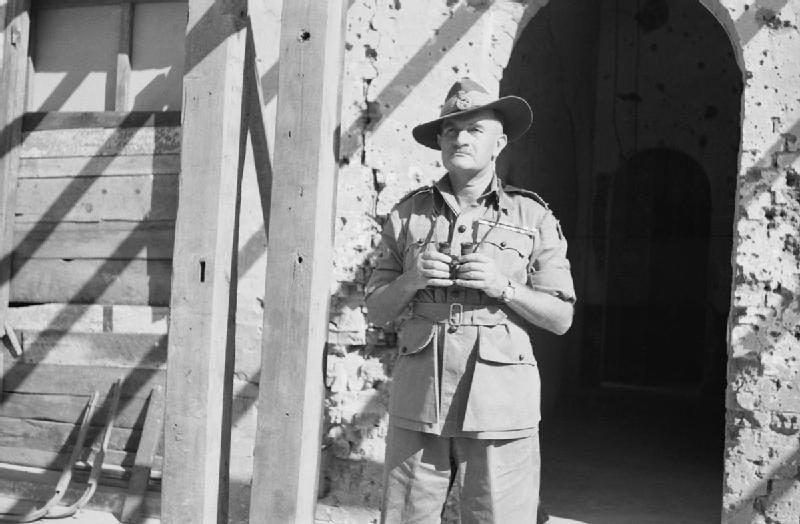
Slim at Fourteenth Army headquarters in Burma, 5 March 1945. Credit: Imperial War Museum.
When the men of the Fourteenth Army in Burma spoke of their commander, they called him "Uncle Bill". It was an unusual nickname for a field marshal, and it tells you most of what you need to know about William Slim. He was not a flamboyant commander, and he never sought the limelight. He was a plain-spoken, unpretentious soldier who had risen from a clerk's desk in Birmingham to the highest rank in the British Army, and who took command of a defeated army in the jungle and turned it into a victorious one. The men he led in Burma were known, bitterly, as the "Forgotten Army", because the war in the Far East came last in Britain's priorities and last in the newspapers. Slim never forgot them, and they never forgot him. His campaign in Burma — the defence of India at Imphal and Kohima in 1944, and the reconquest that followed — was, in the words of the National Army Museum, Britain's finest land victory of the Second World War. Field Marshal Lord Mountbatten later called him "the finest general World War Two produced".
Early life and the First World War
William Joseph Slim was born on 6 August 1891 at Bristol, the younger son of John Benjamin Thomas Slim, a commercial traveller, and his wife Charlotte Amelia, née Tucker. The family moved to Birmingham, where he was educated at St Philip's Catholic School in Edgbaston and then at King Edward's School. He left school at sixteen and went to work, first as a teacher in an elementary school and then as a clerk. It was an unremarkable start, and there was nothing in it to suggest a military career. What changed things was the Officers' Training Corps at the University of Birmingham, which he joined while working as a clerk. He had found, almost by accident, the thing he was good at.
When war broke out in August 1914, Slim was gazetted second lieutenant in the Royal Warwickshire Regiment on 22 August. He went to Gallipoli in 1915 and was seriously wounded there that August, in the fighting on the peninsula. He rejoined his battalion in Mesopotamia in October 1916, and was wounded again and awarded the Military Cross in 1917. He had learned his trade the hard way, in two of the most punishing campaigns of the war, and he had learned something else that stayed with him for the rest of his life: that a commander's first duty was to the men under him, and that soldiers would follow a man they trusted. He was given a permanent commission in the Indian Army in 1918, and posted to the 1st Battalion, 6th Gurkha Rifles, of which he became adjutant in 1921. On 1 January 1926 he married Aileen Robertson at St Andrew's Church in Bombay. She was to be his companion for the rest of his life, and he dedicated his great book about Burma to her.
The Indian Army between the wars
The years between the wars made Slim the officer he became. He attended the Staff College at Quetta from 1926 to 1928, served at Army Headquarters in Delhi, and was an instructor at the Staff College, Camberley, from 1934 to 1936, teaching the next generation of staff officers. He attended the Imperial Defence College in 1937, was promoted lieutenant-colonel in 1938 and given command of the 2nd Battalion, 7th Gurkha Rifles, and in 1939 became commandant of the Senior Officers' School at Belgaum. He had served with Gurkhas for most of his career, and he had a deep respect for Indian soldiers that never left him. He was also, unusually for a soldier, a writer. He wrote stories and articles under the pen name "Anthony Mills", and the habit of writing clearly and plainly about soldiering would later produce one of the great memoirs of the Second World War.
Slim was not a fashionable officer. He had no private income, no influential patrons, and no brilliant staff appointment in London to recommend him. What he had was a reputation as a clear thinker, a good trainer of men, and a commander who understood the ordinary soldier. When war came again in 1939, he was fifty years old and still a lieutenant-colonel, a solid but unspectacular career. The next six years would change that completely.
East Africa and the Middle East, 1940–41
On 23 September 1939 Slim assumed command of the 10th Indian Brigade. In November 1940 he led it in the attack on Gallabat, on the Sudan–Ethiopia border, in the opening stages of the campaign against the Italians in East Africa. Soon after the attack he was wounded in an air attack, and sent his mother a telegram that has become part of his legend: "Bullet Bottom Better Bill". It was typical of the man — cheerful, self-deprecating, and unwilling to make a fuss about a wound. He recovered and was promoted acting major-general, taking command of the 10th Indian Division in May 1941. In the months that followed he led the division in the Anglo-Iraqi War, in the Syria–Lebanon campaign of June and July 1941, and in the invasion of Persia in August 1941. It was hard, varied campaigning, against different enemies in different terrain, and it taught him the value of mobility, of air supply, and of keeping an army moving when its lines of communication were stretched to breaking point. All three lessons would matter in Burma.
The Burma retreat, 1942
In March 1942 Slim was recalled to India and given a harder task than any he had faced. He was appointed acting lieutenant-general commanding I Burma Corps — "Burcorps" — in the middle of a disaster. The Japanese had invaded Burma in January, Rangoon had fallen, and the British, Indian and Chinese forces in the country were falling back towards India in disorder. Slim took command of a corps that was retreating, short of supplies, and outnumbered, and he brought it out. Between March and May 1942 he conducted a controlled withdrawal of some 900 miles to Imphal, in India, bringing the survivors of his corps with him. It is described as the longest retreat in British Army history, and the important word is "controlled": it was not a rout. Slim kept his force together, kept it fighting when it had to fight, and got it to India in a state from which it could be rebuilt. On the disbandment of Burcorps in May 1942 he was appointed to command XV Corps.
The retreat taught Slim a great deal about the Japanese, and about his own army. The Japanese were superb jungle fighters, fast-moving and aggressive, but they were also lightly equipped and dependent on capturing British supplies. The British and Indian troops, by contrast, were poorly trained for jungle warfare, badly supplied, and suffering from malaria and dysentery as much as from enemy action. Slim understood that the problem was not the courage of his men — they had fought hard in the retreat — but their training, their health, and their morale. He set out to fix all three.
Rebuilding the Fourteenth Army
In the Arakan in 1942–43 Slim clashed with the commander of Eastern Army, Lieutenant-General Noel Irwin, who tried to have him relieved. Irwin was himself removed, and in October 1943 Slim was appointed to command the newly formed Fourteenth Army. It was the army that would fight the Burma campaign, and Slim set about remaking it. He introduced proper jungle-warfare training, so that his men could fight the Japanese on their own terms. He taught them aggressive tactics, and he taught them to fight in defensive "boxes" — strongpoints that could be supplied by air and hold out when surrounded, turning the Japanese tactic of encirclement against itself. Above all, he worked on morale. He talked to his men, simply and directly, explaining what they were fighting for and what he expected of them, and he made sure they were fed, doctored and rested. He understood that an army's health was a military problem, not a medical one: malaria was killing more men than the Japanese, and he made the prevention of disease a command responsibility. The men responded, and they gave him the nickname that stuck: "Uncle Bill".
Slim's approach was the opposite of the remote, grand-manner generalship of the time. He was approachable, he listened, and he never asked his men to do anything he would not do himself. He also had the confidence of his superiors. Lord Mountbatten, the Supreme Allied Commander in South East Asia, backed him, and later said that Slim was "the finest general World War Two produced". It was a remarkable judgement from a man who had worked with most of the Allied commanders of the war.

Slim wearing the Fourteenth Army badge. Credit: Imperial War Museum.
Imphal and Kohima, 1944
In March 1944 the Japanese launched their invasion of north-east India, Operation U-Go, aiming to take Imphal and Kohima and to cut the road to China. It was the greatest test of Slim's generalship, and he had prepared for it. Rather than meeting the Japanese on the border, he drew them on, letting them advance into India and stretch their supply lines, while his own forces, supplied by air, held firm in their defensive boxes. The decisive fighting came in May, June and July 1944, at Imphal and at Kohima, where a small garrison held a ridge against repeated Japanese attacks in some of the most desperate fighting of the war. Slim's army held, and then it counter-attacked. The Japanese, starving and out of ammunition, broke and fell back. They lost more than 60,000 men, according to the National Army Museum, and they never recovered. The battles of Imphal and Kohima were the turning point of the war in Burma, and the National Army Museum calls them Britain's finest land victory. It was also a victory won by an army that, two years earlier, had been in full retreat.
The reconquest of Burma
With the Japanese broken, Slim went over to the offensive. His army crossed the Chindwin, took Akyab in the Arakan, and won bridgeheads across the Irrawaddy. In February and March 1945 his forces captured Meiktila and Mandalay, the old royal capital, in a brilliant campaign of manoeuvre that outwitted a larger Japanese force. In May 1945 Rangoon was reoccupied, in a combined air and seaborne operation, with IV Corps still some thirty miles away when the city fell. Slim had retaken Burma in little more than a year, from the moment the Japanese were stopped at Imphal to the moment the capital was back in Allied hands. He was promoted general on 1 July 1945, and as the war ended on 15 August 1945 he took over Allied Land Forces South East Asia from Lieutenant-General Sir Oliver Leese. There had been a difficult episode after Rangoon, when Leese decided to replace Slim; the decision was quashed in London, and Slim remained in command to the end of the war. It is worth recording plainly, because it shows how close the army came to losing its best general at the moment of victory.

Slim as Commander-in-Chief, Fourteenth Army, 1947. Credit: National Army Museum.
Later life and legacy
After the war Slim became Commandant of the Imperial Defence College, serving from 1946 to 1948, and then retired. He became deputy-chairman of the Railway Executive, a civilian job that suited his talent for organisation. But the Army was not finished with him. In November 1948 he was recalled to become Chief of the Imperial General Staff, the professional head of the British Army. He took office on 1 November 1948 and relinquished it on 1 November 1952, with his formal appointment to the Army Council from 1 January 1949 and his promotion to field marshal on 4 January 1949. He was the first Indian Army officer to hold the post of Chief of the Imperial General Staff, a remarkable end to a career that had begun as a clerk in Birmingham. He was appointed GBE in 1946, GCB in 1950, GCMG in 1952, GCVO in 1954, and Knight of the Garter in 1959, in addition to the Distinguished Service Order of 1943 and the Military Cross of 1917.
In 1953 Slim was appointed Governor-General of Australia, and he was sworn in on 8 May that year. He served until 2 February 1960, and in 1954 he welcomed Queen Elizabeth II on the first visit to Australia by a reigning monarch. He was created Viscount Slim of Yarralumla and Bishopston in 1960. He later served as deputy-constable and lieutenant-governor of Windsor Castle in 1963, and as constable and governor in 1964. He died on 14 December 1970 at St Marylebone in London, aged seventy-nine, and was given a full military funeral at St George's Chapel, Windsor, before cremation. There is a plaque to him in the crypt of St Paul's Cathedral, and a statue of him at Whitehall, unveiled by Queen Elizabeth II in 1990.
Slim's reputation rests above all on his book, Defeat into Victory, published in 1956 and dedicated to Aileen. It is one of the great memoirs of the Second World War: clear, honest, and free of self-pity or self-promotion. It sold more than 100,000 copies, and it is still read by soldiers today. He followed it with Courage and Other Broadcasts in 1957 and Unofficial History in 1959. The book's title is also the best summary of his career. He took an army that had been defeated and turned it into an army that won, not by genius alone but by the steady, unglamorous work of training, supply, health and morale — and by a belief, which he stated plainly to his men, that they were as good as any soldiers in the world. The men of the Fourteenth Army, the "Forgotten Army", were never forgotten by their commander. That is why they called him "Uncle Bill", and why his statue stands in Whitehall today.
Sources
- National Army Museum, "William Slim: The soldiers' soldier" — https://www.nam.ac.uk/explore/william-slim
- Australian Dictionary of Biography, "Sir William Joseph Slim" — http://adb.anu.edu.au/biography/slim-sir-william-joseph-11713
- National Army Museum collection, Slim portrait c.1947 — https://collection.nam.ac.uk/detail.php?acc=1951-02-10-2
- Imperial War Museum, Slim photographs SE 3310 and IND 3595 — https://commons.wikimedia.org/wiki/File:Field_Marshal_Sir_William_Slim,_General_Officer_Commanding_Fourteenth_Army_in_Burma,_5_March_1945._SE3310.jpg and https://commons.wikimedia.org/wiki/File:British_Generals_1939-1945_IND3595.jpg

No comments:
Post a Comment